

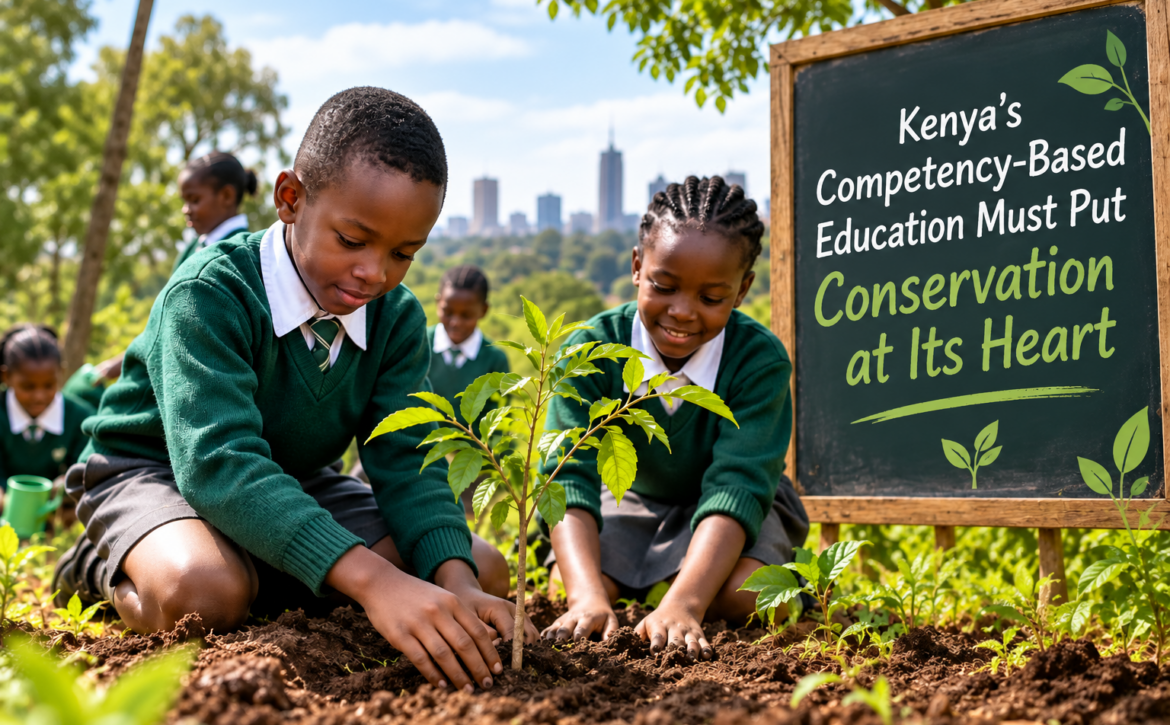
Why Kenya’s Competency-Based Education Must Put Conservation at Its Heart
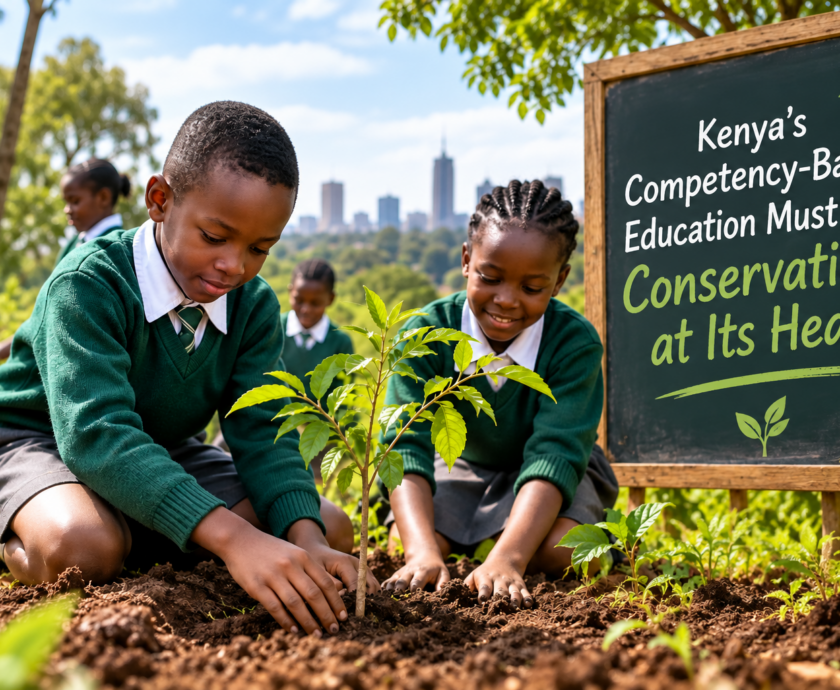
I still remember the day we were handed seedlings at Lower Kabete Primary School and told, quite sternly, that planting a tree was not the end of the lesson. We were warned that if our trees died, there would be consequences. So we watered them, fenced them, checked on them during break time and felt a quiet pride each time a new leaf appeared. I am not sure whether those trees are still standing today. But for a young boy, watching something you planted take root and grow was a powerful lesson in responsibility, patience and care for something bigger than yourself. That simple school experience is what Kenya risks losing if the Competency-Based Education (CBE) system does not deliberately and deeply embed conservation at its core. As the country debates learning outcomes, assessment methods and the future of work, we must also ask a more fundamental question: what kind of citizens are we raising and what kind of country will they inherit?
Today’s school children are not just learners; they are the future custodians of Kenya’s forests, rivers, grasslands and urban green spaces. They will make decisions that determine whether Kenya remains ecologically rich or slides further into environmental crisis. If conservation is treated as an optional topic rather than a lived, practical competency, we will have failed them and ourselves.
Kenya has been here before. For an earlier generation, conservation was not an abstract concept but a daily practice, thanks in large part to initiatives like the 4K Clubs. “Kuungana, Kufanya, Kusaidia Kenya” was more than a slogan. It shaped how young people related to land, farming, trees and community. Pupils learned by doing: tending school gardens, planting trees, keeping livestock and understanding that productivity and conservation could go hand in hand. Those clubs quietly nurtured a generation that understood that development did not have to mean destruction.
The genius of the 4K Clubs was that they treated conservation as practical development. You learned that healthy soil meant better harvests, that trees protected water sources and that caring for the land was an investment in the future. Conservation was not framed as a sacrifice but as the most sensible form of development available. CBE, in theory, offers Kenya a chance to revive and modernize this approach. Its emphasis on competencies, values and real-world learning should make conservation central, not peripheral. But this will only happen if environmental stewardship is intentionally designed into the curriculum, assessed meaningfully and supported with resources.
Schools are uniquely placed to help children understand a truth that policy debates often miss: conservation is development. A conserved forest regulates water, supports agriculture, creates jobs and improves public health. Protected green spaces make cities more livable and resilient. When children grasp this early, they grow up seeing environmental protection not as an obstacle to progress, but as its foundation.
The consequences of failing to instill this understanding are already visible. The ongoing disputes around Ngong Road Forest, including attempts to excise forest land for luxury developments and the contentious claims involving land associated with North Highridge
Primary School, are not just legal or planning failures. They are symptoms of a deeper societal gap: a weakened conservation ethic. When forests are seen primarily as real estate opportunities rather than public ecological assets, something has gone wrong in how we educate and socialize citizens. One cannot help but wonder whether such situations would be as frequent or as brazen if generations had grown up with a strong, practical conservation education. If every child understood the long-term value of an urban forest, the ecosystem services it provides and the rights of future generations, public resistance to such encroachments would be instinctive and overwhelming. CBE can change this trajectory if it moves beyond textbooks and examinations. Conservation must be experienced. Let learners plant trees and be responsible for them over years, not days.
Let schools adopt nearby rivers, forests or wetlands as living classrooms. Let environmental challenges in local communities become problem-solving exercises. Assessment should reward care, consistency and impact, not just recall of facts. Teachers, too, need support. A conservation-focused curriculum requires training, tools and partnerships with environmental organizations, community groups, and county governments. When schools are connected to real conservation efforts, learning becomes relevant and transformative.
Kenya prides itself on its natural heritage, from iconic wildlife to critical water towers. Protecting this heritage will not be achieved by policy documents alone. It will be achieved when conservation becomes part of a child’s identity, just as it once was for those of us who feared
letting our school trees die. As Kenya refines the Competency-Based Education system, conservation should not be an afterthought or a cross-cutting theme lost in implementation. It should be a central pillar.
The children sitting in classrooms today will decide the fate of our forests tomorrow. If we ignite a conservation ethic early, grounded in practice and pride, we may yet raise a generation that understands that the most ideal form of development is one that allows both people and nature to thrive.
An opinion article written by Job Mwangi, an Advocate of the High Court of Kenya and the Advocacy Manager at the Green Belt Movement